



Evershine’s Work Principles – A Fellowship Manual Towards a 1,000-Person Organization
Introduction to this service (PDF) Click to download PDF file
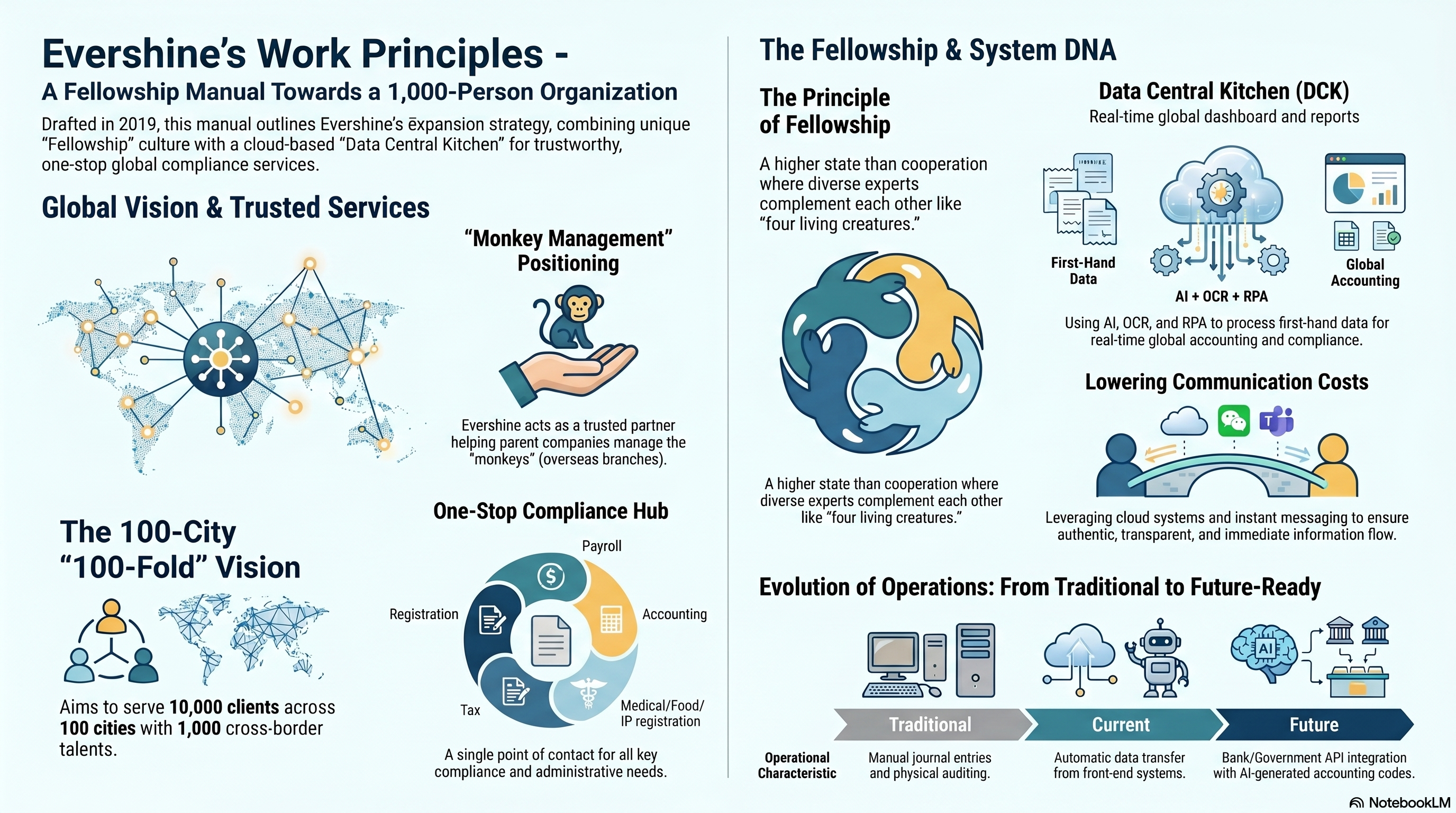
EvershineCPA drafted “Evershine’s Work Principles” in 2019 when there were about 80 people. Now in 2026, with around 160 people, it has been used for 7 years and gone through over 20 versions of revisions and additions. It is expected that “Evershine’s Work Principles” will continue to be: a fellowship manual for Evershine moving towards a 1,000-person organization. The content below is extensive; you can download the PDF file for each chapter to study them chapter by chapter.
Chapter 1: Principles
1.0 Introduction to the PDF content of this chapter Click to download PDF file
1.1 Enriching Principles Accompanies Evershine’s Growth
A. As Bridgewater (Ray Dalio) grew from 60 people to over 750, they did two things:
a1. Occupational personality trait testing to make the best use of talent.
a2. Enriching work principles; Ray wrote down the decision-making principles behind every action, discussed them with everyone, and gradually revised them.
B. When there were 60 people, Ray Dalio handled all big and small decisions; as the number of people grew, problems arose.
C. Actually, if you know for sure that your supervisor’s idea is a certain way, you don’t need to ask more; you can just execute it. If you are unsure of the supervisor’s idea, you need to seek confirmation upwards.
D. The public discussion of principles is to reduce the number of items that require upward confirmation.
1.2 What are Principles?
A. Principles are not just for reference without normativity; but they are also not inflexible, allowing for temporary or provisional measures.
B. Principles are not SOPs (Standard Operating Procedures), but they are the foundation of SOPs.
C. Principles will also be gradually revised and advance with the times, just at a slower pace of change.
D. Principles are divided into work principles and life principles.
d1. Work principles: The underlying logic behind every action and decision, summarized from repeated parts after accumulation.
d2. Life principles: The life values and life meanings upon which every work principle is based, summarized from repeated parts after accumulation.
Logo, Vision, Fellowship Culture, Goal, Personnel Arrangement, Code of Conduct
E. Different cultures create different principles. There is no right or wrong. Examples are as follows:
A control tower operator in Kuala Lumpur told the captain of a waiting commercial airliner: “Currently, flight path F350 requires a 20-minute wait, but F310 is available immediately. Do you want to choose F310?”e1. Basic Data:
F350 (35,000 feet high altitude) is fuel-efficient, saving NT$1.2 million compared to F310 (31,000 feet high altitude).
e2. China Airlines Pilot’s Principle:
Safety, comfort, time (preferring longer time in the air), and economy (low altitude has high resistance and consumes more fuel). They would choose F310 because China Airlines pilots’ salaries are calculated based on the time spent in the air.
e3. EVA Air Pilot’s Principle:
Safety, comfort, economy (high altitude has low resistance, saving NT$1.2 million), and time (the shorter the time in the air, the better). They would choose F350 because EVA Air pilots are paid per trip. They will speed up while flying at F350.
Chapter 2 Evershine’s Mission and the 100-City Vision
2.0 Introduction to the PDF content of this chapter Click to download PDF file
2.1 Financial and Accounting Needs Have Not Changed Since Ancient Times
A. Financial Statements:
Balance sheets, income statements, cash flow statements;
The more timely and accurate they are, the more valuable they are to shareholders, creditors, etc.
BIG 4 CPA Firms Focus on these relevant services.
B. Regulatory Compliance:
Investment regulations, business tax, corporate income tax, withholding tax, labor and health insurance, pensions, leave and attendance; you cannot violate the law.
Evershine Focus on these relevant services.
C. Management Information:
For operators to make judgments; Personnel part: distributing performance bonuses; Products and services: cost and pricing information.
ERPs Focus on these relevant services.
2.2. Evershine’s Positioning: Providing Trustworthy Services for Overseas Branches of Multinational Companies
Evershine’s positioning = Cross-border + Multi-country + One-stop + Professional services.
When working in a listed company managing and supervising 23 overseas subsidiaries of the overseas business division, colleagues joked: “You are managing 23 monkeys.”
Monkeys jump around, are hard to handle, and sometimes climb over your head.
Our positioning is: “Helping the parent company manage the monkeys,” which means helping the parent company manage its overseas branches.
To date, we have managed over a thousand monkeys.
The CFOs or investment department heads of parent companies are very grateful for this monkey-management service we provide.
Making clients feel at ease, trusting us, and handing over the monkeys to our management; seeing their satisfied expressions and receiving their thanks is Evershine’s glory.
Providing trustworthy services for overseas branches of multinational companies.
2.3 Evershine’s Service Items
One-stop service items required by overseas branches of multinational companies include:
A. Personnel mobility-related and Employment Outsourcing Services (EOS);
B. Company personnel payroll operations and compliance services;
C. Company registration and legal-related services;
D. Accounting, cashier, tax, international tax, and project audit services;
E. Trademark and patent registration services;
F. Medical devices, cosmetics, and food compliance registration.
A. Personnel mobility-related and Employment Outsourcing Services (EOS)
a1. Short-term Employment Outsourcing Services, known as labor dispatch in mainland China.
a2. Drafting personnel contracts
a3. Handling personnel labor disputes
a4. Work permit application, residence permit processing
a5. Immigration services
a6. Cross-border individual income tax filing services
a7. High-level talent agency services
B. Company personnel payroll operations and compliance services
b1. Payroll calculation (Gross-To-Net)
b2. Payroll collection and payment
b3. Individual income tax withholding collection and payment
b4. Social and health insurance premium collection and payment
b5. Leave and overtime processing
C. Company registration and legal-related services
c1. Company registration
c2. Special license registration
c3. Personnel contracts
c4. Handling personnel labor disputes
c5. Immigration law consulting in various countries
D. Accounting, cashier, tax, international tax, and project audit services
d1. Business tax declaration
d2. Expenses, income
d3. Individual income tax withholding
d4. Corporate income tax declaration
d5. Provisional tax calculation
d6. Corporate income tax settlement and declaration
d7. Preparation of financial statements, inventory, and cost reports
d8. Cashier payment arrangement, proxy invoicing
d9. Arranging financial or tax audits
d10. Cross-border expense payment and compliance processing
d11. Project audit services
E. Cross-border trademark application and patent annual fee payment services;
e1. Cross-border trademark application services
e2. Cross-border patent annual fee payment services
F. Medical devices, cosmetics, and food compliance registration.
f1. Cross-border medical device compliance registration
f2. Cross-border cosmetics compliance registration
f3. Cross-border food compliance registration
2.4 Description of the Vision to Develop into 100 Cities in the Future
A. 100 cities, 10,000 clients, annual revenue of USD 100 million, average USD 10,000 per client.
a1. Each city should have Inbound execution functions and Outbound business functions.
a2. The Inbound of each country learns from Wan Hai Lines: 60% direct operation by ourselves, 40% entrusted to external collaborative partners.
a3. The Outbound of each city needs a Certified Public Accountant or a Partner Level professional at the senior manager level, responsible for undertaking the outbound expansion business of multinational parent companies, and collaborating with Evershine colleagues in the invested countries.
a4. Partner Level professionals can be trained by adding current colleagues who serve clients expanding overseas from Taiwan and China.
B. Evershine’s Development Milestones.
b1. When the number of clients reaches 20, we start to purchase an office. The office needs to accommodate services for 80 companies, and additional offices can be rented in the same building to cope with business expansion.
b2. When 20 cities each exceed 20 clients, it is time for us to handle capital increases from internal personnel and external legal entities.
b3.
When 10 cities each exceed 100 clients, these 10 cities will have their own offices, capable of handling 60% of the Inbound business in that country, and possessing Outbound business functions.
b4. Evershine collaborating to go public is part of Marketing and Branding; it creates a reason for clients’ handling personnel to choose Evershine’s services.
b5. When Evershine has about 3,000 clients, we can afford the annual listing maintenance fee of 10-20 million, which is the time to go public.
b6. It is expected that after going public, due to the brand effect, the number of clients will increase from 3,000 to 6,000 within 2-3 years.
2.5 Cultivating 1,000 Cross-border Management and Compliance Talents
A. Evershine aspires to become a cradle for cultivating cross-border management and compliance talents.
B. This training is implemented not only for Evershine’s internal employees but also for clients’ employees and partners.
2.6 How to Cultivate Inbound Business Service Managers for Various Cities
A. Must be or be able to arrange: A professional with a CPA license, tax accountant license, or a qualified accounting certificate.
B. For business registration, must be or be able to arrange: A professional with a qualified Company Secretary license or Notary to execute.
C. Every country must have its own above-mentioned personnel in a certain city.
D. The Taipei Headquarter must have someone responsible for communication and coordination.
E. In the city where the client’s parent company is located, Evershine’s own colleagues or partners should join the collaborative service to win business in other cities for that parent company.
F. Use systems like QIS, DCS, IMS, Billing, WRSR, AIS, BIZ, etc., to collaborate.
G.
When holding meetings with people of different native languages across borders, use Teams Meeting + Wordly.ai to break through language barriers.
Tips for Using Combined Teams and Wordly.ai Language Settings
2.7 How to Copy Taiwan’s Outbound Business Experience to Other Cities?
Chapter 3 Evershine Cloud Service Platform
3.0 Introduction to the PDF content of this chapter Click to download PDF file
3.1 The Future Determines the Present, the Whole Determines the Parts
A. Constantly think about how future societal and technological changes will determine the direction, and use this as the basis for present decisions.
B. Observe from multiple dimensions to understand the whole, and use this as the basis for partial decisions.
C. Become a futurist with insight into the future: Think more about the future, read more.
D. At all times, try to think 30 years ahead to make present decisions.
3.2 Evolution and Development of Accounting Operations
A. Evolution of Tools:
Abacus
Calculator
PC
Intranet Server ; Inside ERP
Cloud Server ; Cloud-based ERP
Cross Cloud Server. RPA (Robotic Process Automation)
AI+OCR+API=Data Central Kitchen
B. Evolution of Operations:
T-accounts generating reports.
Inputting journal entries, and the accounting system automatically posts to generate reports.
Various accounts are automatically transferred from front-end management systems to the accounting system to generate reports.
Data exchange between cross-companies generates information management records, which are then automatically transferred to the accounting system to generate reports.
C. Characteristics of Evolution:
Information generators input and maintain data at the time and place the information occurs.
The need for manual input and calculation is becoming less and less.
Information exchange is becoming more timely and faster.
There are fewer and fewer audit points requiring manual checks.
Accounting bookkeeping and auditing work are becoming less and less.
D. Predicting the Future Landscape of Accounting Operations
First-hand data possessed in bank computers will be opened up; Japan and many other countries have legislated to require banks to provide data.
First-hand data possessed in the government’s e-invoice system will be opened up.
First-hand data possessed in the computers of suppliers and clients will continue to expand data exchange.
Every company will have an Accounting Code AI automatic generator.
3.3 Evershine’s DNA: The Principle of First-hand Input
A. Information Processing Principles:
a1. The information generator provides their own information at the time and place of occurrence to relevant people who must know this information;
a2. At the same time, the information system must be set up to be simple and easy, allowing the information generator to input the information at the time and place of occurrence.
B. The person who obtains the first-hand data inputs the data into the system;
b1. Manual input or APP input or FTP
b2. AI + OCR automatic recognition input
C. Evershine’s services and system design tend to:
c1 Be input by the information generator in various front-end departments themselves, not by accounting personnel; Evershine provides services but does not input on behalf of clients.
c2 Due to this information processing principle, we generally do not provide traditional bookkeeping services acting on behalf of the client.
c3 If the client has already inputted data themselves, we transfer their data files over and continue processing.
D. The client keeps a running journal, and the system can directly post it:
d1 Due to this information processing principle, Evershine’s system is distinguished from other systems on the market.
d2 A senior expert in the accounting service industry once said: “I have a dream. If there is a system that allows clients to just keep a running journal, and the system can directly post it, then the market will be huge.”
d3 Now, we have realized this senior expert’s dream.
3.4 Principles of Data Exchange with External Systems
A. We should try our best to obtain first-hand data possessed in banks, government e-invoice systems, suppliers, and client computers.
a1. Japan and many other countries have legislated to require banks to provide data to operators.
a2 The e-invoice systems of the governments in Taiwan and China allow import and export.
a3. Many company computer systems allow import and export, including data exchange with systems used by local tax accountants & auditors in various countries.
a4. If the first-hand data possessed in Evershine’s computers is needed by other institutions, such as suppliers and clients, we should try to export it.
B. Data exchange methods between different systems:
b1. Using File Exchange method in Excel or Txt format.
b2. Using API method.
b3. Using RPA to simulate human manual large-scale repetitive data entry.
b4. AI + OCR + RPA massive processing into Excel or Txt, then imported into the ERP system.
3.5 Data Central Kitchen (DCK)
The 3-in-1 combination technology of AI + OCR + RPA produces a Data Central Kitchen for various purposes.
AI = Artificial Intelligence; OCR = Optical Character Recognition; RPA = Robotic Process Automation).
The combination technology of AI+OCR+RPA excels in the pre-processing or preprocessing of various documents and files.
In the future, there will be Data Central Kitchens for various purposes + matched with ERPs to produce automated operations that were previously impossible.
3.6 New Landscape of the Global Accounting Service Industry – Supported by the Data Central Kitchen
A. New Landscape of Accounting Journalizing Operations:
a1. The future appearance of commercial financial accounting systems is predicted to be the exchange of data between various database servers.
a2. Evershine must become a value-added service provider for the government’s e-invoice database.
a3. On one hand, our clients can use our system to deposit sales invoices into the government’s e-invoice database, ensuring our services in Taiwan won’t be eliminated; on the other hand, we can use the client’s vouchers to help them retrieve input invoices for accounting or verification.
a4. For example, we can design an APP that clients can download on their phones to report expenses, just by filling in the input invoice number. This is because the input invoice number can be used to call up the e-invoice content obtained from the government’s e-invoice database.
a5. Furthermore, we can develop an Accounting Code AI for the company, install it, and during operation, it can gradually generate accurate accounting codes through machine learning based on the Payee, Applicant, and text within the invoice.
a6. This will make journalizing simple and fast.
a7. Therefore, obtaining the qualification of a private value-added service provider for the IRS e-invoice database is very important.
B. New Landscape of Future Financial Accounting System A/R, A/P Write-off Operations
b1.
It is a global trend that bank transaction data will gradually be opened up to relevant vendors; Japan has even legislated requiring banks to open up.
b2. In Taiwan, we can already obtain collection data from E.SUN Bank almost in real-time; of course, successful payment data can also be obtained very quickly.
b3. In B2B transactions, one company’s payment equals another company’s collection. By obtaining bank transaction data, we can simultaneously write off one company’s A/P and another company’s A/R.
b4. After the third-party reconciliation system is completed, it can allow the details behind one company’s unpaid A/P to match the details of another company’s uncollected A/R. Thus, by grabbing a certain code in the bank transaction details, it can achieve the function of mutual reconciliation and write-off.
C. Financial & Accounting Data Central Kitchen + Evershine’s ERP = Automated Operation Evershine Platform
The 3-in-1 combination technology of AI+OCR+RPA produces a Data Central Kitchen for the financial and accounting industry, supporting Evershine’s ERP, generating an automated financial and accounting operation platform that was previously impossible.
3.7 Principles for Developing Information Systems for Organic Growth
Customization supports organic growth:
All good systems must be customized to be truly satisfactory. Even within the same company, all systems must change as the organization changes; it is organically grown.
There is no such thing as a packaged system in the world that can be used in a company without any modifications.
Coexistence of uniformity and variability:
A good information system has uniformity and variability. Individual variations are allowed within a uniform system. Meaning: customization under a restricted scope and established rules.
All individual variations are expressed within uniformity. Meaning: Customization must be executed under a restricted scope and established rules.
Cloud systems facilitate updates:
Moving forward is the source of creativity. The business world changes very fast, and planning often cannot keep up with the changes. Only by continuously trying can we know the facts and innovate.
After cloud systems are changed, they are only uniformly updated on the platform. This allows the system to continuously update forward.
Information brews within the operational process:
The best information system brews within the operational process, allowing the information generator to operate smoothly at the time and place the information occurs.
Then, relevant personnel obtain the necessary important information from it.
The new system must be usable not only by Evershine itself but also by clients:
New system development must have the potential to be used by clients and generate revenue.
Systems used solely by Evershine itself usually will not develop into good systems.
System planning takes 90% of the time:
Understand that when IT personnel complete an information system, 90% of the time is spent understanding the system specifications and the impact of relevant data updates on other systems.
If there is a translator who understands both accounting and the needs/specifications of information systems, they are an extremely valuable talent in Evershine.
Pathways for cultivating system planning talents:
EXCEL is not enough; one must learn Microsoft Access.
Encourage and subsidize obtaining Access certification, listing it as an award category at the Spring Banquet.
Testers are indispensable:
Understand that after the information system is written; the relevant system testers (commonly known as guinea pigs) may have to spend several times the amount of time testing it.
Therefore, revising while fixing, the initial users (commonly known as guinea pigs) are usually quite miserable, but this is a necessary process.
However, buying a ready-made system that cannot be modified and cannot grow organically will limit enterprise development. Developing and testing important systems in-house is a necessary evil.
It will be fine once the golden cross point is passed.
3.8 Principles of Co-construction of Three Railways Among Different Systems
A. Japan Railway (JR) Lines, Shinkansen, and Subways co-exist.
a1. It is not necessary to tear down previously built systems; new programs and tools can be used to build new systems.
a2. The Shin-Osaka co-construction system of three railways in Japan.
B. Building a more user-friendly co-constructed operating system
b1. If not co-constructed, meaning passengers have to go back to the first-floor entrance every time to enter, it becomes inconvenient.
b2. Shinkansen (High-Speed Rail), JR Line (TRA), Subway (MRT) are at the same station. Every floor is interconnected, tickets can be shared, and it is also a large shopping mall (Banqiao Station, Taipei Station, Nangang Station).
b3. Regardless of where the passenger is, the signs pointing to where they want to go are very clear; there are no misleading signs.
b3. Inspiration: Bring over the Default values, understand the context, bring the values over, and do not repeat doing the same things.
C. The co-construction among Evershine’s various systems has always been carefully considered, but needs further strengthening:
c1. Avoid having to re-enter from the entrance into other system modules every time. It should be possible on the user’s screen to link to the screens of other modules when necessary, and bring existing data values over as Default values for the other module’s screen. Every operation on a screen should be self-explanatory, and unnecessary buttons should disappear or be Disabled (to avoid misleading).
c2. Only the users know best about the co-construction needs among Evershine’s various systems, and they must raise these needs. IT personnel do not know. If colleagues encounter the above scenarios, please do not hesitate to raise them; IT personnel will be added if necessary.
3.9 Principles for Establishing Internet Banking
A. Supporting Cashier Operations:
a1. The system supports file uploading to avoid errors, misplaced targets, and incorrect amounts.
a2. All clients should establish internet banking accounts as payment tools to help them control cash flow. Principle of consistent amounts: The payment amount on the PI slip and the collection amount on the RI slip must match the amount in the bank passbook.
a3. Principle of no cash handling: Set up a three-party internet banking approval function (Maker, Reviewer, Approver). Personnel from the Evershine Taipei parent company will act as the Maker, using the Evershine system to support file uploading, allowing clients to avoid hiring cashiers locally, and letting the parent company directly control the remittance of funds.
B. Supporting Regulatory Compliance Review Services:
b1. Because there are regulations to follow in every country when paying for goods or expenses, such as having legal vouchers, some needing to be transferred to payroll, and some requiring withholding tax. Before payment, it must be pre-reviewed by Evershine personnel before it can be paid, so as to avoid constantly doing clean-up work. Since parent company personnel face barriers in regulatory compliance and language, they desperately need this service from us.
b2. This is not just a question of whether the system is good or bad; it is also what distinguishes our services from other traditional CPA firms, which provide bookkeeping services just for tax reporting with two sets of books.
C. Timing for Establishing Internet Banking:
c1. When we initially help a client set up a company, during the bank account opening stage, we must set up the mechanism for Evershine personnel to act as the Maker on internet banking. This is a key factor concerning whether we can provide this client with labor-saving and high-quality services in the future. Please note: Asking clients to add Evershine parent company personnel as the Maker in internet banking’s three-party approval is advanced but unconventional, and it requires effort and explanation to achieve. Usually, more conservative clients will agree: Having a main account and a petty cash account, opening at least the petty cash account for us to be the Maker is not a problem.
c2. Principles are not just for reference without normativity; but they are also not inflexible, allowing for temporary or provisional measures.
D. Current Status of Internet Banking Establishment:
d1 Currently, for 2/3 of our clients, Evershine personnel act as the Maker on internet banking. Some were set up during business registration.
d2. Some are gradually set up after establishment.
Chapter 4 Business Development
4.0 Introduction to the PDF content of this chapter Click to download PDF file
4.1 Principle of Business Autonomy
A. Try to face clients directly and sign contracts directly with clients as much as possible.
B. If there are referred cases, we sign the contract, we collect the money, and we pay the referral fee.
C. If there are referred cases where the other party collects the money from the client and then pays us, it is only appropriate if the company is at least 5 times larger than us or if their business model is worth learning from. Moreover, it should not exceed 20% of Evershine’s revenue.
D. For any of our service capacities in any city, we do not grant exclusive business development rights to any client or service provider.
E. For any of our services in any city, we do not grant exclusive cooperative service rights to any single partner.
4.2 Principle of 100-Fold Growth
A. The Necessity of Growth:
a1. Healthy growth is the absolute principle; running a business is like sailing against the current: if you don’t advance, you retreat.
a2. The growth of recurring revenue is the best way to solve all problems within the organization.
a3. Continuous healthy growth allows good talent to enter and be trained, providing a basis for salary increases, forming a positive cycle.
a4. As the company grows larger, it is seen, forming a brand, which brings in business, creating a positive cycle.
B. 100-Fold Growth
b1. 100-fold growth usually takes 20-30 years to achieve, prompting you to pay attention to future societal and technological changes to determine directions.
b2. The strategies and methods required for 100-fold growth usually cannot be achieved merely by moving forward from the current situation; innovative, preemptive, and grand-scale approaches must be adopted.
b3. You must provide clients with high cost-performance ratios to achieve 100-fold revenue growth. On one hand, you must seek price reductions from partners.
b4. On the other hand, we must develop tools to reduce the operational and communication costs for ourselves and our partners.
C. The Future Determines the Present, the Whole Determines the Parts
c1. Constantly think about how future societal and technological changes determine directions, and use this as a basis for present decisions.
c2. Observe from multiple dimensions to understand the whole, and use this as a basis for partial decisions.
c3. Become a futurist with insight into the future: Think more about the future, read more.
D. Always Keep in Mind:
d1. The organization, personnel, business items, revenue, and annual output value per person when growing 100-fold.
d2. The current situation.
d3. The dynamic planning for every 5 years from now to the next 30 years.
d4. The annual dynamic planning for the next 5 years.
d5. The 52-week dynamic planning for the next 1 year.
d6. The daily dynamic planning for the next 1 week.
E. Approach and Mentality:
e1. Do not deliberately push forward, and do not deliberately hold back. When there is an opportunity, do not let it go just because you cannot do it yourself; think about collaboration to win the business.
e2. You must grow even with insufficient resources; growing in a resource-deficient environment is the best university for cultivating perseverance.
4.3 Principle of Recurring Revenue
A. Recurring Revenue is the most core concept in our business development strategy.
B. Some stand-alone service items cannot independently become Recurring Revenue services, but when combined with other service items, they can generate Recurring Revenue.
C. Company registration and subsequent services (payroll, accounting, tax) are complementary. Company registration brings new clients, and subsequent services will generate other company registration services and bring referral business services.
D. Other new business items or expansions to new cities should also follow this principle.
E. Government bids are typical non-Recurring Revenue service items; they should only be accepted if the unit price is good.
F. If non-Recurring Revenue services require special expertise and have a good unit price, they can be paired with the principle of borderless personnel arrangements.
4.4 Principle of Continuously Increasing Value-Added —Increasing Average Salaries
A. The net business revenue per employee per year must continuously increase for salaries to rise.
B. Creating client value and reducing communication costs must proceed simultaneously; the Hourly Rate must be high.
C. High unit-price services usually have a small market; conversely, services with high competition usually have lower unit prices.
D. On one hand, we must strive for clients willing and able to pay higher service fees; on the other hand, we must reduce our own communication costs to strive for these high-volume but lower-fee clients.
E. There are 2 ways to increase annual income per capita, P * Q: one is to increase the unit price, the other is to increase the number of clients served.
F. If we can collaborate, integrating different expertise to provide services that other providers cannot offer, the unit price will be higher. Services that require the group to work together are usually higher-value services. Services that only a few people can learn in a short time are easily replicated and easily replaced by competitors!
G. If communication costs can be reduced, each colleague can serve a larger number of clients.
H. Paul Lee from the Evershine Bilingual Toastmasters Club once said: Competitiveness in the business world lies in having lower “transaction costs” than peers. And the most important thing in the service industry is having lower “communication costs” than peers.
I. Some seemingly overly competitive industries or services, after successfully reducing communication costs, turn into items with very high annual output value per person, and these are large-volume items. We should start from this aspect. New markets and new service items are usually small in volume.
J. In short, simplify and shorten processes; make the transmission of information as flat as possible. Allow relevant personnel to get information in real-time.
4.5 Principle of Creating Client Value —Looking for Red Flower Clients
A. High Value-Added Services
a1. Providing the same service to different client groups will result in different valuations of the service we provide, and thus different willingness to pay service fees.
a2. To increase the annual revenue per person and synchronously raise the salary level of Evershine colleagues, we will naturally strive for clients willing to pay higher service fees.
a3. Services that require the group to work together are usually higher-value services. Services that only a few people can learn in a short time are easily replicated and easily replaced by competitors!
B. Red Flower Clients, Green Leaf Clients, and Weed Clients:
b1. According to the 80/20 rule, about 20% of the number of clients generate 80% of the profit. These 20% of clients can be called Red Flower Clients;
b2. Of the other 80% of clients, about 72% can be called Green Leaf Clients.
B3. Of the other 80% of clients, about 8% can be called Weed Clients.
C. Inclusively Serving Red Flower Clients and Green Leaf Clients
c1. Red flowers may fade and wither, and green leaves may become red flowers due to environmental changes. Therefore, Green Leaf level clients have the potential to become Red Flower level clients.
c2. Red flowers also need green leaves to set them off; without green leaves, red flowers alone are not beautiful. We cannot reject taking on Green Leaf Clients.
c3. Some Green Leaf Clients may initially lack the ability to pay the service fee for our minimum service level, but if they could potentially be Red Flower Clients in the future; initially we don’t know which one is a Red Flower Client, this is judged by frontline personnel.
c4. Some Green Leaf Clients initially lack the ability to pay our minimum service fee, and even if they grow in the future, transaction volume increases, we need to spend a lot of time, and they are still unwilling to increase the service fee, they will become the following Weed Clients!
D. Weed Clients refer to clients that must be eliminated:
d1 Clients with tax or legal risks who ignore repeated advice and insist on breaking the law.
d2. Because the operational process is not smooth, we have to spend a lot of time. Compared to the time spent, the Hourly Rate of the service fee is too low. We propose suggestions to improve the process, but the client consistently refuses to accept them.
d3. Because the transaction volume is large, we have to spend a lot of time. Compared to the time spent, the Hourly Rate of the service fee is too low. We propose suggestions to increase the service fee, but the client consistently refuses to accept them.
d4. Weed Clients are clients we must eliminate. But even for Weed Clients, we do not actively drive them away; we can only raise the price and let the companies unwilling to pay leave automatically.
d5. The client is always right, but not paying is wrong. Unless there are other considerations, clients who do not pay are also Weed Clients.
E. Principle of Tiered Services
e1. Dedicate more effort to Red Flower Clients to take care of their quality;
e2. For Green Leaf Clients, who are unlikely to become Red Flower Clients in the future, just provide the normal standard high-quality service; there’s no need to over-serve.
e3. For Weed Enterprises, we do not actively drive them away either; we must strengthen communication, explain the risks, explain methods to improve processes, and explain the reasons for raising service prices. If they truly cannot accept it, give them a 3-month to 1-year notice period to allow unwilling companies to leave.
4.6 Principle of Mastering Timing —The Sun Moon Lake Story
A. Sun Moon Lake Story: A boat capsizes at Sun Moon Lake; the boatman rescues them
a1. The person falling into the water is a rich man.
Several timings: Falling into the water waiting for rescue > Grabbing the sampan > On the boat > On the shore > At home;
Shift in mentality: Entire fortune > Half > 1 million > 100,000 > A box of Mid-Autumn mooncakes.
a2. The person falling into the water is an ordinary person.
Might be 10,000 > A box of Mid-Autumn mooncakes.
B. Exploring Rationality
b1. The competencies that enable the boatman to save people, including the cost of the sampan paid by himself, proving his abilities, whether it is a rich man or an ordinary person, we must step in to save them.
b2. In the service industry, the value of the service is the value recognized by the client, not looking at one’s own costs. In this example, the boatman catching fish might only earn 1,000-4,000 dollars a day.
b3. To the rich man: a reasonable amount should be 1 million; to the ordinary person: it might be 10,000.
b4. Please note that this is the price the client is willing to pay because it generates value for them; it cannot become something the client perceives as taking advantage of their precarious position.
b5. Please note that in practice, it is not easy for us to know the price the client is willing to pay; one must have communication skills.
C. Execution Timing
c1. Signing the contract on the boat, only then does the boatman give up his fishing job for the day to specially bring them back to the shore.
c2. Whether a rich man or an ordinary person, if they don’t sign the contract, they just continue fishing with us and go home at night.
c3. If it is a poor person who cannot afford to pay, we also save them, but they just continue fishing with us and go home at night.
c4. To get the service income we deserve, interacting with clients requires signing the contract at the appropriate timing.
c5. Failing to master the timing, the colleagues following you will only have Mid-Autumn mooncakes to eat.
c6. Understand that once that timing has passed, it is twice the effort for half the result.
4.7 Principles for Handling Inquiries from Clients about New Service Items
A. When receiving a new demand from a client that exceeds current service items, there are four possibilities:
a1. We already provide this service item but you are unaware of it;
a2. It is a potential service item we want to develop ourselves, which we can currently undertake and then outsource to partners;
a3. It is a service item we do not want to develop or currently lack the confidence to undertake, which can be referred to other partners;
a4. It is an item to Say No to.
Explanation for a1:
Some services require cross-departmental projects. In an individual department, it may seem undoable, thinking we don’t have this service, but actually, it can be done with a little integration.
Some services are already provided to other clients, but individuals do not encounter them ordinarily and need to cooperate with other colleagues to provide them.
Explanation for a2:
For some potential service items we want to develop ourselves, we will first find an outsourcing vendor we can cooperate with. After getting the quote from the outsourcing vendor, our firm will draft a quotation for the client.
We must have the ability to manage suppliers. Cooperate with the borderless personnel arrangement; like government bids, it can be adopted. In principle, we collect the money, and we will bear the responsibility; this is only permissible under bearable loss risks.
Explanation for a3:
Some business items may be clearly feasible, just because of different cities, we don’t want to disperse our manpower too much and don’t do it. But if referred to our cooperative partners in different cities, such as IAPA or LEA, etc., we can build a good relationship with them. If clients keep asking in the future, we can consider listing that city as a potential development city. The hardest thing for us to understand is where the clients and markets are? Even in the process of referral, it will cultivate our vision.
Explanation for a4:
Directly Say No to new services or new markets.
Conclusion:
Todd said: When a new company starts doing Marketing and Branding, clients will observe you for 5 years before they feel at ease.
When you say “NO” to a client, it will take another 5 years. Therefore, unless you do not want to step into that market or business, do not easily say “No” to clients. Anyway, just propose a solution; clients do not care if you do it yourself or outsource it. The service fee might be slightly higher when outsourced, but it’s up to the client to decide whether to accept it, rather than saying “NO” to the client. Realizing that a client has this demand is highly valuable information, so when receiving an inquiry for a new service item, you must report it upwards. Before saying No, it is best to report upwards to the Principal Partner to make the final decision.
4.8 Principles for Entertaining and Receiving Guests
A. There are roughly three types of entertaining and receiving guests:
a1. Quick Lunch;
a2. Formal Banquets;
a3. Local guiding or providing vehicle assistance.
B. Quick Lunch (bento or dining out is fine)
b1. We usually do not formally entertain potential clients who are in discussions; but having a Quick Lunch together is also a very important part of KYC.
b2. However, if a meeting goes past noon, whether it’s a potential client or an existing client, a Quick Lunch must be arranged.
b3. Taiwanese people generally prefer Japanese cuisine (bento or dining out is fine).
b4. For foreigners, it must suit their cultural traditions.
C. Formal Banquets
c1. Generally, when bosses or high-level decision-makers of Red Flower or Green Leaf clients visit, if a formal banquet is needed, it will be arranged by the Principal Partner and accompanied by manager-level staff. If the guest is a foreigner, personnel with a TOEIC score of 860 or above must be arranged to accompany them.
c2. Generally, if bosses of Green Leaf clients, staff, or handlers of Red Flower clients visit, they can be entertained by manager-level staff, accompanied by the personnel handling the case. If the guest is a foreigner, personnel with a TOEIC score of 860 or above must be arranged to accompany them.
c3. Reference restaurants: Smexy or other restaurants.
D. Arranging Local Guiding or Providing Vehicle Assistance – Clients visiting from afar
d1. We do not socialize or bribe clients to win or maintain clients.
d2. If bosses or employees who have already become clients come from abroad and are not familiar with Taiwan, especially guests coming to Taipei for the first time, we should consider assisting the clients so that they have a solid understanding and a good experience in Taipei, treating it as citizen diplomacy! Treat them just like visiting relatives and friends, including local guiding and driving to scenic spots, not purely for Evershine’s benefit.
d3. If suggesting to proactively assist in arranging local guiding or providing vehicle assistance, please report to the Principal Partner for approval first, and then proactively ask the client if they need assistance. Since the Taipei MRT is very convenient and the internet is highly developed, many international business people have their own ideas and arrangements and do not want to be disturbed. Therefore, we do not need to force clients to accept.
d4. If the client proactively or implicitly asks us to be a local guide, drive to scenic spots, etc., please report to the Principal Partner to judge whether to accept and arrange it.
Chapter 5 Transaction Costs
5.0 Introduction to the PDF content of this chapter Click to download PDF file
5.1 Principle of Transparent and Authentic Information
A. Assuming everyone receives authentic and identical information, the probability of them reaching the same final decision should be very high.
B. Information must be highly transparent to relevant people so that everyone can reach a consensus.
C. But do not invite unnecessary people to join business meetings.
D. WeChat-group is also a form of rapid meeting.
E. Do not try to train employees by adding unnecessary people to a WeChat-group, making it a nuisance to others.
5.2 Principle of Lowering Communication Costs
A. The service industry focuses on lowering “Communication Costs”
a1. Paul Lee from the Evershine Bilingual Toastmasters Club once said: Competitiveness in the business world lies in having lower “transaction costs” than peers. And the most important thing in the service industry is having lower “communication costs” than peers.
a2. Some seemingly overly competitive industries or services, after successfully reducing communication costs, turn into items with very high annual output value per person, and these are large-volume items. We should start from this aspect. New markets and new service items are usually small in volume.
B. Methods to lower “Communication Costs”:
b1. For example, we use cloud systems to create a collaborative work environment, allowing the information generator, at the time and place of occurrence, to input into the cloud system in real-time, so relevant personnel can receive the information synchronously anytime, anywhere.
b2. For example, we use WeChat-Group, Teams-Group, E-mail, etc., to synchronously transmit and receive information.
b3. For example, our depth of work in each field ranges from entry-level 1 to levels 2, 3, 4, up to the highest level 5. When a department has more people, it must equip its own personnel to handle level 1 to level 2 work content of other departments, the purpose of which is still to reduce communication costs.
b4. If there is a middleman passing messages left and right between two parties, consider whether the two parties can communicate directly and straightforwardly, while you can observe the conversation between both sides.
b5. When holding meetings with people of different native languages across borders, use Teams Meeting + Wordly.ai to break through language barriers.
Tips for Using Combined Teams and Wordly.ai Language Settings
5.3 Collective Effort —Principle of Instant Communication
Using instant messaging software to set up group discussions is a highlight of Evershine’s client services.
A. Special Group Naming Rules:
a1. This special naming rule applies to group-wechat, group-Whatsapp, group-email.
a2. syd-ci-SimosaOil: City code – Group characteristic code – Company name.
B. Group Characteristic Codes
b1. s: site client staff (Local client staff)
b2. c: client staff (Parent company client staff)
b3. r: referrer or Relation keeper in client-end
b4. i: internal in Evershine
b5. p: partner in site (Local cooperative partner)
C. City Codes
c1. Google Keyword: City + international airport IATA code
c2. “Shenzhen + international airport IATA code” >> szx
c3. Cities are named according to their airport codes in IATA, which can be searched on Google.
c4. Sfo-San Francisco; tyo-Tokyo; sel-Seoul; pek-Beijing; xmn-Xiamen; tpe-Taipei; han-Hanoi; sgn-Ho Chi Minh; bkk-Bangkok; sin-Singapore; cgk-Jakarta; mnl-Manila; bom-Mumbai; del-New Delhi; syd-Sydney; lon-London; fra-Frankfurt; ber-Berlin.
D. Country Codes
d1. ISO Codes used in Domains
d2. Taiwan.tw, China.cn, Japan.jp, South Korea.kr, Philippines.ph, India.in, Indonesia.id, Thailand.th, Malaysia.ma, Vietnam.vn, Singapore.si, Germany.de, UK.uk, USA.us
E. Group Establishment Principles:
e1. In principle, each project may have about 3 groups: -i-, -ci-, -ip-; In principle, every group has internal in Evershine personnel.
e2. Collective effort – Roles are defined during the kick-off meeting when the group is established: Who is s? i? c? r? p? Relevant personnel are Grouped together.
e3. Some people pull the cart, some push the cart.
e4. With collective effort in operation, meetings can be held at any time, information flows freely at any time, prevention is better than cure.
F: Bewd – Example and Implementation
f1. Parent company client group; Wechat-group; pek-ci-Bewd
f2. Evershine internal group; Teams-group; pek-i-Bewd
f3. Cooperative partner group; Wechat-group; pek-ip-Bewd
f4. Mailbox Bewd_Beijing@evershinecpa.com
G. Embio – Example and Implementation
g1. Parent company client group; Teams-group; szx-ci-EmbiQ
g2. Evershine internal group; Wechat-group; szx-i-EmbiQ
g3. Cooperative partner group; Wechat-group; szx-ip-EmbiQ
g4. Mailbox EmbiQ_Shenzhen@evershinecpa.com
H. Project -I- Internal Evershine Personnel Composition Principles
h1. The upstream process + current process + downstream process must be together from the very beginning to avoid asking the client the same question, improving client satisfaction, and reducing our internal communication costs.
h2. Work assignment and organizational development follow the path of least resistance. Arranged in the smoothest way according to the environment and circumstances at that time, shifting from department responsibility to individual assignment responsibility.
h3. The commercial world has gradually become one where everyone is the handler of an independent small department; the supervisor is an assistant and monitor, not the handler. h4. The application of communication software has changed organizational forms; the roles of department heads and team members have drastically changed in the past, and the concept of a supervisor completely controlling all detailed affairs of department personnel has gradually faded.
Chapter 6 Personnel Configuration
6.0 Introduction to the PDF content of this chapter Click to download PDF file
6.1 Organization and Personnel Configuration Principles
A. Peter Drucker said:
To build a client-oriented organization, when client needs change, the organization and personnel configuration must change accordingly.
Whether it is a large enterprise or a small enterprise, a public enterprise or a family enterprise, an enterprise using high-end management tools or manual management, there is no absolute good or bad organization, it depends on whether the organization can meet the needs of the clients.
B. Personnel configuration changes with proficiency:
b1 New personnel should focus deeply on a specific scope of work and not cross into too many fields initially.
b2. Once new personnel are familiar, add more tasks to diversify their competencies.
b3 Low-volume, highly diverse work should be handled by supervisors or senior personnel.
C. Organization and personnel configuration will change as the enterprise’s scale changes:
d1. When the organization is small, all business is concentrated in one person or group, low volume and highly diverse, with rich competencies.
d2. When the organization becomes relatively larger, the division of labor will become increasingly detailed.
When a colleague is overwhelmed because the business volume increases (i.e., low-volume high-diversity becomes high-volume high-diversity), the work must be split up and relevant personnel assigned to do it together.
d3. For example, our functional division of labor:
Marketing & Branding, Quotation, Engagement Signing, Implementation, Execution and Daily Practice. Previously it would be concentrated in one person or group, but as clients increase, the division of labor must be more detailed.
d4. For example, our market-based division of labor:
The Execution and Daily Practice part would be concentrated in one person or group, but as clients increase, it will be divided by cities, or divided into payroll services and financial/tax services.
D. Organization and personnel configuration will change according to the tools used by the enterprise
Introducing various software will affect personnel configuration; for example, introducing OFFICE 365, instant messaging software like WeChat, Teams, etc., will all cause changes to the organization and personnel configuration.
6.2 Principle of Fellowship
A. Only business items requiring fellowship and cooperation have long-term competitiveness:
a1. If we can collaborate, integrating different expertise to provide services that other providers cannot offer, the unit price will be higher.
a2. Services that require the group to work together are usually higher-value services.
a3. Services that only a few people can learn in a short time are easily replicated and easily replaced by competitors!
a4. Fellowship is a higher state than Cooperation.
B. Peter Drucker said:
b1. Do not expect to be able to hire all-around geniuses, but rather build a work environment that allows mutual fellowship and a culture of fellowship, so colleagues with different expertise can complement each other.
b2. We must admit that we are all ordinary people, but because we partnered together in the past, we achieved what Evershine is today; in the future, we must continue to exert the spirit of fellowship.
C. Wang Yung-ching said:
c1. If things go smoothly and you are there, no matter what, you have credit.
c2. If things do not go smoothly and you are a member of it, no matter what, you have shortcomings.
c3. If personal goals conflict with group goals, the personal part should be put aside first.
D. The most vivid description of fellowship comes from the four living creatures described in the Book of Ezekiel in the Old Testament of the Bible.
d1. The respective advantages of the man, lion, ox, and eagle. The man has a man’s advantages, the lion has a lion’s advantages, the ox has an ox’s advantages, and the eagle has an eagle’s advantages.
d2. The four living creatures are joined together, each facing east, west, south, and north. When they move, none of them turn around:
When the man moves forward, the lion and the ox move sideways, and the eagle moves backward;
When the horse (lion) moves forward, the man and the eagle move sideways, and the ox moves backward;
When the ox moves forward, the man and eagle move sideways, and the horse (lion) moves backward;
When the eagle moves forward, the lion and ox move sideways, and the man moves backward.
d3. Ezekiel describes:
The four living creatures are powerful, move swiftly, darting up and down, fast and slow. This typifies an ideal, powerful, and dynamic state of the church.
E. Fellowship to display Evershine’s best image:
e1. During daily operations, in certain occasions such as business negotiation stages, if the CFO of a foreign parent company visits, or during online meetings with high-level decision-makers of a foreign parent company, these are important occasions where Evershine’s best image and strength must be displayed.
e2. When a task comes, at that moment, if the combined abilities of the original members are relatively weak compared to the actual abilities that Evershine’s overall resources can exhibit, you must think of bringing in or seeking superiors to arrange personnel from other departments to fellowship, to display Evershine’s best image and strength.
e3. For example: during the business negotiation stage, if an English Presentation is needed: two groups of people; some colleagues know the business or the BPO system but their English is not fluent; some colleagues have good English but are unfamiliar with the business or BPO system; if two groups report using a translation method, the failure rate might be very high.
e4. At this time, you must Rehearse so that the person strong in English becomes familiar enough to present, while the person familiar with the business acts as backup, or think of the fellowship principle, seeking superiors to arrange personnel from other departments to fellowship, to display Evershine’s best image and strength, and increase the success rate.
e5. For example: When the CFO of a foreign parent company visits, or during online meetings with high-level decision-makers of a foreign parent company, these are important occasions where you must think of the fellowship principle, seeking superiors to arrange personnel from other departments to fellowship, displaying Evershine’s best image and strength, to enhance Evershine’s impression on these decision-makers.
e6. When holding meetings with people of different native languages across borders, use Teams Meeting + Wordly.ai to break through language barriers.
Tips for Using Combined Teams and Wordly.ai Language Settings
F. The principle of fellowship and the principle of urging self-growth stack on each other:
f1. Principle of urging self-growth: Encourage taking responsibility, encourage trial and error, encourage engaging in problem-solving, encourage lifelong learning. If every colleague just improves by 1% each week, that’s a 52% growth in a year.
f2. Evershine does not expect to hire all-around geniuses, but hopes that senior colleagues can gradually cultivate the various competencies Evershine needs, the more the better.
f3. But no matter how hard our colleagues try to grow, they will still find that at work, when serving local clients, colleagues still need to fellowship with each other to get things done.
f4. Facing international competition, the actual ability that Evershine’s overall resources can exhibit might already be considered weak; if discounted further, it becomes too weak. Fellowship is a must.
G. Evershine’s measures in establishing a fellowship work environment:
g1. Using instant messaging software to establish group discussions, implementing collective effort – the principle of instant communication by setting up Wechat-Groups, Teams-Groups, Email-groups; spanning across different times, zones, and languages. Junior or new colleagues act as handlers, while senior colleagues and supervisors monitor.
g2. Every case is divided into -i- internal; -ip- internal + partner; -ci- Client + Internal.
g3. If there is a middleman passing messages left and right between two parties, consider whether the two parties can communicate directly and straightforwardly, while you can observe the conversation between both sides.
g4. For the principles of Evershine’s internal personnel composition for Project -I- Internal, please refer to 5.3 Collective Effort — Principle of Instant Communication.
6.3 Principle of Matching Personality Traits
A. Concepts of applying occupational personality trait tests:
a1. Personality traits are neutral; there is no good or bad. For example, introversion or extroversion cannot be said to be better than the other.
a2. Different companies have different corporate cultures. Every company has its suitable combination of occupational personality traits, which needs to be identified through occupational personality trait testing.
a3. Within the same company, each project or department requires people with different personality traits to fellowship together, which also needs to be identified through occupational personality trait testing.
a4. Within the same company, different positions require different professional skills and corresponding personality traits, which also need to be identified through occupational personality trait testing.
a5. In summary, using occupational personality tests as an aid more accurately places talent in the right positions, allowing colleagues with those personality traits to work without feeling like they are going against their nature, so they feel happy.
a6. Evershine must understand what the appropriate combinations of occupational personality traits are for each department and each position within our corporate culture, to serve as a reference for future talent selection and cultivation.
a7. If talent selection is correct, the human resources cycle is half successful.
B. The practice of Japan’s SoftBank (Business Weekly Issue 1611, 2018-10-07, P.68)
b1. Since 2015, they used IBM Watson to read various documents filled out by current employees during their application written tests, including autobiographies, to find out the words or topics that frequently appeared in the written tests of these outstanding colleagues.
b2. Then they compared the words or topics in the data of new hires with the norm to find model talents.
b3. It seems to have been somewhat effective.
C. Finding the company’s own norm:
c1. Different companies have different corporate cultures; every company has its own norm.
c2. Within the same company, the norms for different departments will also be different.
c3. Within the same company, the norms for different positions will also be different.
c4. The representatives of all current employees in the company are a group of people who identify with the company culture.
c5. Conduct occupational personality trait testing on the entire company’s current employees to generate a norm to serve as a reference for future talent selection.
D. Referring to the norm during talent selection:
d1. New personnel use the occupational personality trait test questionnaire.
d2. After filling out the paper copy, it is handed over to a designated person to input and generate a form.
d3. Before hiring, compare and refer to the norm, so as not to be like blind men feeling an elephant.
E. Types of occupational personality trait tests
MBTI Test; DISC Test; Big Five Test; 16 Personality Test etc.
6.4 Cheerful and Optimistic 20190416 Dale Chen
A. Cheerful and optimistic displays positive energy:
Giving people hope, direction, strength, wisdom, confidence, and happiness!
B. Examples of the benefits of an optimistic personality:
b1. A master’s student in biomedical engineering: artificial joint surgery has an 85% success rate and a 15% failure rate; concluding negatively meant problems and failure to graduate; changing it to a positive focus allowed graduation within a month.
b2. I shared at my father’s memorial service: Because my father was cheerful and optimistic, we children and grandchildren really liked to take him out to play, and my cousin said he was very envious. Even though his father was very rich, he never wanted to take him anywhere because he was nagging.
b3. Miss An and Minh Liu used to be colleagues: Miss An had a negative personality, even knowing she was in Sydney, Minh didn’t want to contact her.
b4. Someone asked Akio Nitori: What is the most important personality trait for a supervisor? Akio Nitori said it is being cheerful and optimistic.
b5. Akio Nitori, Founder and Chairman of Nitori; 400 billion Yen; 100 billion in profit; 520 stores.
b6. When Akio Nitori was young, he had to deliver rice in the cold winter and was very reluctant, putting on a long face. Before he went out, his mother called him back and told him to show a cheerful and optimistic face.
b7. Nitori had a bank they dealt with go bankrupt. When going to another bank with a long face, he was rejected. Before looking for the next bank, he thought of his mother’s instructions before going out in the winter when he was a child, so he went to discuss with the bank cheerfully and optimistically, successfully converting the loan.
b7. Being cheerful and optimistic allows us to gather a happy collaborative team to move forward together. Being cheerful and optimistic also helps us find resources to overcome the difficulties we face. Bosses do not have the right to be pessimistic; they can only move forward cheerfully and optimistically.
b8. A client of Evershine recently encountered the same situation. I shared this story, and they managed to raise the money.
C. As for how to cultivate cheerful and optimistic traits?
c1 Internal cultivation:
Eating food makes people grow strong; the difficulties encountered in daily life or at work are food, blessings in disguise.
Human nature is inherently good. We are not fighting against people, but against Satan behind them, and we must rely on the Lord to win.
c2. External practice:
c2-1 Like soldiers from the outside in, cheerful and optimistic people do not mumble their words; they articulate clearly, have a loud voice, show confidence, have good body language, and have cadence in their tone.
c2-2 Reading aloud with “gritted teeth” Exercise your mouth muscles to improve our tone. Clear articulation commands respect automatically.
c2-3 Display: Rejoice always, pray continually, present your requests to God. Singing with “gritted teeth” Display: What a beautiful jasmine flower…;
c2-4 “Speak like a pundit” to speed up your speaking rate.
D. Conclusion:
d1. My most anticipated trait for Evershine colleagues: Cheerful and optimistic.
d2. Let us be mentally optimistic no matter what situation we encounter, no matter what pressure we face.
d3. In action, practice speaking powerful and pleasant words through “gritted teeth,” and show a confident smile.
d4. Gradually make it a habit and cultivate a cheerful and optimistic personality trait.
6.5 Principles of Cultivating Chinese/English Abilities and Breaking Through Language Limitations
A. Reference CTCI Corporation: When colleagues participate in the TOEIC exam, the registration fee for the first time is paid by the company; for the second and subsequent times, if the score improves compared to the last time, the registration fee is paid by the company.
B. Taiwanese employees must be able to communicate in English, and foreign employees must be able to communicate in Chinese. We need to cultivate colleagues with both Chinese and English abilities = 60% of the total number of employees.
C. For foreign-related personnel in Taiwan, the target TOEIC score is 760 or above.
D. For those dispatched overseas from Taiwan, besides professional skills, a TOEIC score of 860 or above is required.
E. During new recruitment, attention should be paid to whether the TOEIC score is 760 or 860 or above? When professional skills are equal, priority is given to the one with the higher TOEIC score.
F. Current Evershine colleagues whose TOEIC score was originally below 760 or 860, and who reach 760 or 860 or above during their employment, should be commended and encouraged at the annual Spring Banquet, just like passing the Excel certification exam.
G. Current colleagues try to use Teams+Wordly.ai to break through language barriers. 20260411 revised.
Tips for Using Combined Teams and Wordly.ai Language Settings
H. AI language translation has a very high accuracy rate when one end is English. Therefore, it is still necessary to learn English as an intermediary for AI translation.
6.6 Various Countries’ Compliance Map Training Plans
A. Training Targets
We will hold training courses on international business, payroll, labor, and tax compliance for those interested; both internal and external sessions will be held.
B. Principles for Selecting Internal Trainees
b1. Mandatory for the overseas team.
b2. Mandatory for corporate registration legal personnel.
b3. Mandatory for key business contacts in Taiwan.
b4. Mandatory for department heads, especially those who need to cooperate with other departments.
b5. Other interested personnel.
C. Internal Employee Training Plan:
c1. A total of about 6 half-days, 1.5 hours per class, 2 classes per half-day;
c3. In the 12 classes, within each 1.5-hour class, 50% is lecturing, and 50% is learning, filling out feedback forms, and giving oral presentations.
c3. Internal training courses include work principles.
D. External Client Training Plan:
d1. The external target is the list of contacts in our QIS over the past few years.
d2. 3 hours (half a day) for each country per session, 1.5 hours per class, total 2 classes;
d3. The first class is corporate registration (including international conceptual framework), the second class is payroll and tax (including international conceptual framework);
d4. Within each 1.5-hour class, 80% is lecturing, and 20% is learning and writing/returning feedback forms.
E. Training on using ChatGPT
6.7 Principles for Screening Expatriate Personnel
A. Familiar with Evershine’s Cloud system.
B. Passed the COMPLIANCE MAP training for various countries’ compliance.
C. Familiar with Evershine’s work principles.
D. TOEIC 860 or above, or proficient in using Teams+wordly.ai to break through language barriers. 20260411 revised.
Tips for Using Combined Teams and Wordly.ai Language Settings
E. No one can possess all the conditions; we still need to fellowship with each other, but the more conditions you possess, the greater your chances.
6.8 Principle of Hiring Personnel Across Nationalities
A. Reflections on the French football team winning the championship on July 15, 2018.
a1. At the Evershine Bilingual Toastmasters Club on June 26, 2018, Miss Lee asked which football team I liked?
a1. My answer was: The French team.
a2. They specifically recruit brave, outstanding youths from poor areas who have not yet become famous. Winning matches brings both fame and fortune, and behind excellence is ascetic-like self-discipline.
a3. In football, two moves are the most dangerous: sliding tackles and headers; once famous, if targeted by other teams, attempting to make plays is very dangerous. Star players, once famous, don’t want to make dangerous moves. A national team relying solely on star players is impractical.
a4. These two moves were the French team’s supreme strategy for winning the championship.
a5. Other national teams seem constrained by nationality and lack the clear goals of the French team. The French team, composed of members from multiple countries, won the championship. To win the championship, meritocracy is used, accepting French team members originally from various countries.
B. Why could we see France’s strategy at a glance?
b1. Because: Evershine’s strategy for recruiting talent shares similar thoughts with the French football team.
b2. Adhering to the “High Value-Added Management Method”, Evershine distributes 50% of the value-added amount to all employees, while allowing colleagues to report their performance independently. The performance obtained by each department serves as an important reference standard when paying annual salaries, known as the “Internal Entrepreneurship Principle”.
b3. This allows capable and motivated colleagues, regardless of which country they are from, to earn the fruits of their hard work based on the same “Internal Entrepreneurship Principle”.
6.9 Principle of Employing Personnel Across Internal and External Boundaries
A. The barriers between internally hired personnel, outsourcing partners, and consultants must be broken down.
B. Cloud systems must be used to construct a collaborative work environment.
C. Performance evaluation must be able to quickly reflect the efforts and contributions of operational personnel.
D. We have the WRSR (Weekly Revenue Statistical Report) allowing outsourcing partners to independently report their performance, serving as an important reference standard for payouts.
Chapter 7 Organizational Structure
7.0 Introduction to the PDF content of this chapter Click to download PDF file
7.1 Principle of Overlapping Arrangements for Entry-Level 1-2 Work Among Units
A. Principle of Professional Overlap: Each department has the ability to handle entry-level operations in other related professional fields.
a1. Lower transaction costs are the key to corporate competitiveness; in the service industry, it’s communication costs.
a2. Levels 3, 4, 5 are transferred out; similar to the 5-level system of medical laboratory centers:
The system for various human medical tests is usually divided into 5 levels; clinics are level 1 specimen collection sites, outsourcing all testing; general hospitals have attached level 2 small labs; regional hospitals have attached level 3 labs; national hospitals have attached level 4 labs; international-level facilities set up exclusive level 5 labs.
a3. Similarly: When a department is small, everything is outsourced (internally or externally); after each department grows, to reduce communication costs with other departments, it is more appropriate to equip its own manpower to handle entry-level 1-2 work. Only when it reaches level 3 depth is it transferred to other departments.
a4. Based on our current organizational cooperation and division of labor, levels 1-5 are all divided.
B. Future organizational development should adopt the principle of overlapping arrangements for entry-level 1-2 work among units; that is:
b1. The accounting and tax department gradually needs to equip itself to arrange entry-level 1-2 work in corporate registration and payroll;
b2. At the same time, the Taipei corporate registration department needs to equip itself to handle entry-level 1-2 work in payroll, accounting, and tax;
b3. Simultaneously, the payroll department needs to gradually be able to handle entry-level 1-2 work in corporate registration, accounting, and tax.
b4. However, level 3, 4, 5 work is transferred to specialized departments.
7.2 Principle of Project Client Contact Person
A. One project client contact person
B. Parent company city contact person
C. Using the principle of collective effort: scrip
7.3 Principle of Coexistence of Administrative Linear Organization and Project Matrix Organization
A. Administrative Linear Organization
a1. Just like the Egyptian pyramids, everyone has only one superior, all operating normally and executing daily work.
a2. These are common in normal, high-volume operational organizations.
B. However, encountering the following situations requires a project-based organization
b1. Cross-departmental projects
b2. Multinational clients needing a dedicated project contact window
b3. Expansion into new markets
b4. Expansion of new service items
b5. Evershine currently expanding into new markets requires extensive use of project-based organizations.
C. Conditions for Project Operation
c1. Project-based organizations must use instant communication tools like WeChat-Group, Teams-Group, Line-Group, Email-Group to form a “collective effort” mechanism;
c2. When forming a project-based organization, members and their supervisors must be included.
7.4 Principle of Coexistence of Uniformity and Variability
A. Gatherings:
a1. Gathering Uniformity: Singing hymns to praise the Lord, breaking bread and drinking the cup, worshipping the Father, morning revival, sharing for 3 minutes, reading the Bible and sharing for 3 minutes, announcements, serving personnel fixed as much as possible.
a2. Gathering Variability: Personnel changes, songs change, sharing changes, locations change.
B. Toastmasters
b1. Toastmasters Uniformity: Organization has seven roles, table topics, prepared speech variety, evaluation IE, and ten speeches.
b2. Toastmasters Variability: Different languages, different groups.
C. MRT:
c1. MRT Uniformity: Pipe shape, 2 lines arriving, multiple exits.
c2. MRT Variability: Time changes, ticket prices change.
D. Evershine Business Development
d1. Evershine’s Uniformity: Cross-border, cloud supported, Quotation must go through Dale Chen.
d2. Evershine’s Variability: Different cities, different nationalities, different clients.
E. Work Principles
e1. Principle Uniformity: If it conforms to the principles, decide yourself.
e2. Principle Variability: If it does not conform to the principles, exception management.
F. Japan’s MIHO Museum Showcasing a Hidden Shangri-La:
f1. Located in the mountains near Kyoto (like going from Taipei to Wulai and further into Doll Valley), you first arrive at a reception station (village), then pass through a winding tunnel (a glimpse of hope), and arrive at the MIHO Museum (hidden Shangri-La).
f2. Uniformly uses stainless steel and glass throughout, even for the tunnel, roof, and partitions, with consistent colors; but the architectural exterior and interior design are highly variable.
f3. Designed by Chinese architect I.M. Pei, one of the world’s top ten buildings.
f4. Comment by former museum director Lee Wu-kun: There is variability in uniformity, and uniformity in variability. Uniformity in Variability and Variability in Uniformity. Embracing both uniformity and variability.
G. Principle Induction
g1. A good organization: whether a country, government, society, company, or church, all encompass uniformity and variability;
g2. A good operating system: also encompasses uniformity and variability.
H. CTCI Group’s Collective Effort – Embracing Uniformity and Variability:
h1. From the start of the company, the headquarters has used information technology to establish uniformity to support <collective effort>. On the foundation of uniformity, it supports multiple business items and cross-border turnkey engineering operations.
h2. Showing variability during execution: Project general managers collaborate with various functional and regional department managers, making collective efforts to win cross-border turnkey mega-project contracts and deliver them to clients on time with high quality.
J. Evershine is also fortunate to embrace uniformity and variability like CTCI, but it needs to be implemented more thoroughly:
j1. Headquarters uses


